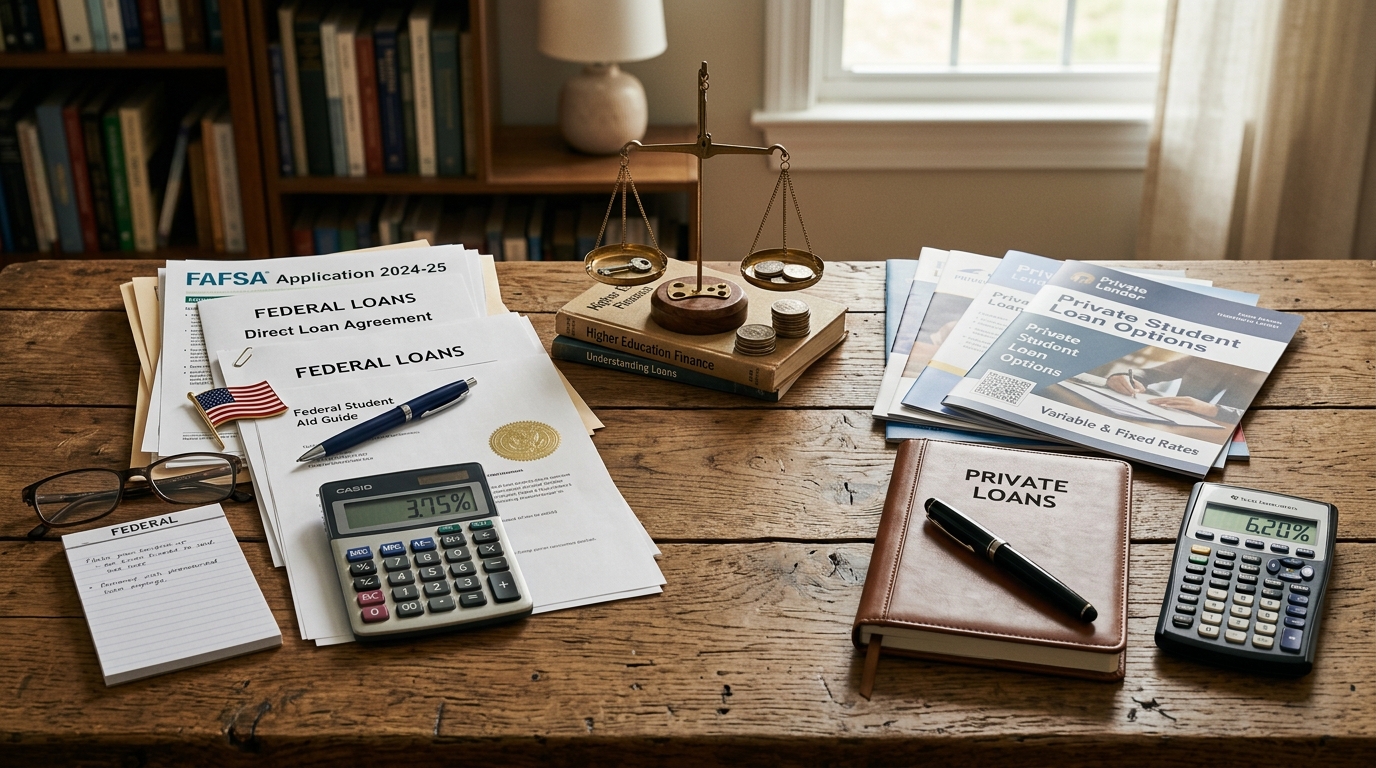
Student loans come in two main types: federal and private. The differences go far beyond the interest rate. Federal loans offer income-driven repayment, forgiveness programs, and death or disability discharge. Private loans don’t. Yet 1 in 10 undergraduates still borrow private loans first, often because the financial aid award letter didn’t cover the full cost. This guide breaks down how each loan works, what to watch for, and how to choose wisely.
Federal Student Loans: The Basics
Federal loans are funded by the U.S. Department of Education. You apply through the FAFSA. The government sets the interest rates, which are fixed for the life of the loan. For 2024-25, undergraduate Direct Subsidized and Unsubsidized loans carry a 6.53% interest rate. Graduate PLUS loans are at 9.08%. These rates reset each July 1 based on the 10-year Treasury note.
There are four main types of federal loans:
- Direct Subsidized: For undergraduates with financial need. The government pays the interest while you’re in school at least half-time and during grace periods.
- Direct Unsubsidized: Available to all students, regardless of need. Interest accrues from the day the loan is disbursed.
- Direct PLUS: For graduate students and parents of undergraduates. Requires a credit check but no debt-to-income ratio.
- Direct Consolidation: Combines multiple federal loans into one, often to qualify for income-driven repayment.
Federal loans come with borrower protections you won’t find in the private market. Income-driven repayment plans cap your monthly payment at 10% to 20% of discretionary income. After 20 or 25 years, any remaining balance is forgiven. Public Service Loan Forgiveness wipes out the balance after 10 years of qualifying payments. Total and Permanent Disability discharge cancels the debt if you become disabled. And if you die, the loan is discharged.
Private Student Loans: What They Are
Private loans come from banks, credit unions, and online lenders like Sallie Mae, Discover, and SoFi. They’re not backed by the government. Interest rates can be fixed or variable. As of early 2025, fixed rates range from about 4% to 15%, while variable rates start around 5% and can climb above 18%.
Your rate depends on your credit score and income. Most students need a cosigner. A cosigner with a 750 FICO score can cut your rate by 2 to 3 percentage points. Without one, you’ll likely pay the highest end of the range.
Private loans have fewer safety nets. There’s no income-driven repayment, no forgiveness after 20 years, and no death or disability discharge in most cases. Some lenders offer forbearance, but it’s limited and interest keeps accruing. If you fall behind, you can default after just one missed payment in some cases.
Comparing Federal vs. Private Loans
Here’s how the two stack up side by side:
- Interest rates: Federal fixed rates are set annually. Private rates vary by lender and creditworthiness.
- Repayment plans: Federal offers standard, graduated, extended, and four income-driven plans. Private usually offers only standard 5- to 15-year terms.
- Forgiveness: Federal has PSLF, teacher loan forgiveness, and IDR forgiveness. Private has none.
- Deferment and forbearance: Federal offers unemployment deferment and economic hardship deferment. Private options are limited and lender-specific.
- Credit check: Federal loans (except PLUS) don’t require a credit check. Private loans always do.
- Loan limits: Federal Direct Loans cap at $31,000 for dependent undergrads and $138,500 for grad students. Private loans have no set limit; lenders decide based on cost of attendance.
In practice, most financial aid experts say to exhaust federal loans first. Mark Kantrowitz, a leading student loan expert, recommends borrowing no more than your expected first-year salary. That rule applies to both federal and private loans, but it’s easier to manage with federal loans because of income-driven repayment.
When Private Loans Might Make Sense
Private loans aren’t always a bad choice. They can be useful if you’ve maxed out federal loans and still need to cover a gap. They can also be cheaper if you have excellent credit and a cosigner. For example, a borrower with a 780 FICO score might get a fixed rate of 4.5% from a credit union, compared to 6.53% on a federal unsubsidized loan.
But the savings come with risk. If you lose your job, you can’t switch to an income-driven plan. If you want to pursue public service, you won’t qualify for PSLF. And if you die, your cosigner may be on the hook unless the lender offers a death discharge.
Some lenders do offer cosigner release after a certain number of on-time payments. SoFi, for instance, releases cosigners after 24 months of qualifying payments. But the bar is high: you usually need to show income and creditworthiness on your own.
How to Decide Which Loan to Use
Start with the FAFSA. It’s the only way to get federal loans, grants, and work-study. Submit it as soon as it opens on October 1 each year. Some aid is first-come, first-served.
Review your award letter. Accept grants and scholarships first. Then accept subsidized loans, then unsubsidized, then PLUS if needed. Only after you’ve exhausted federal options should you consider private loans.
If you do need a private loan, shop around. Get quotes from at least three lenders. Compare the APR, not just the interest rate. Check for origination fees, late fees, and whether the rate is fixed or variable. A variable rate might start lower but can spike.
Consider a cosigner even if you think you don’t need one. A cosigner with strong credit can save you thousands over the life of the loan. Just make sure you both understand the risks. The cosigner is equally responsible for the debt.
Repayment Strategies for Both Loan Types
When you graduate, you’ll have a six-month grace period on federal loans before payments start. Private loans may have a grace period too, but it’s often shorter or nonexistent.
If you have federal loans, look into income-driven repayment. The SAVE plan, for example, caps payments at 5% of discretionary income for undergraduates. If your income is low enough, your payment could be $0. That counts as a qualifying payment toward forgiveness.
For private loans, your best bet is to pay extra when you can. Even $50 extra per month can shave years off your term. You can also refinance later if your credit improves. But refinancing federal loans into a private loan means losing all federal benefits. Don’t do it unless you’re certain you won’t need them.
If you’re struggling, contact your loan servicer immediately. Federal servicers have hardship options. Private lenders may offer temporary forbearance. Ignoring the problem leads to delinquency and default, which can wreck your credit for years.
Conclusion
Federal loans should be your first stop. They come with lower fixed rates, income-driven repayment, and forgiveness options that private loans can’t match. Private loans can fill a gap, but they carry more risk and fewer protections. Borrow only what you need, keep track of your total debt, and have a repayment plan before you graduate. Your future self will thank you.
Q: Can I get a private student loan without a cosigner?
Yes, but it’s harder. Most lenders require a cosigner unless you have a strong credit history and steady income. Without one, you’ll likely face higher interest rates or be denied. Some lenders offer cosigner release after you make a set number of on-time payments, often 24 to 36 months.
Q: Are federal student loans always better than private loans?
Not always, but usually. Federal loans offer income-driven repayment, forgiveness programs, and death or disability discharge. Private loans don’t. However, if you have excellent credit and a cosigner, a private loan might have a lower interest rate. Weigh the savings against the lost protections.
Q: What happens if I default on a federal student loan?
Default occurs after 270 days of missed payments. The government can garnish your wages, seize tax refunds, and withhold Social Security benefits. You can rehabilitate the loan by making nine on-time payments in 10 months. That removes the default from your credit report and restores eligibility for federal aid.
Q: Can I refinance federal loans into a private loan?
Yes, but you’ll lose all federal benefits. That includes income-driven repayment, PSLF, and deferment options. Only refinance if you have a stable job, a solid emergency fund, and don’t plan to pursue public service or need income-based payments. Otherwise, keep your federal loans separate.
Q: How much should I borrow in student loans?
A common rule of thumb says don’t borrow more than your expected first-year salary. If you expect to earn $45,000, keep total debt under $45,000. That keeps monthly payments manageable. Also consider your future career path. A teacher earning $40,000 may struggle with $80,000 in debt, while an engineer earning $70,000 can handle more.
Article Was Generated By AI.