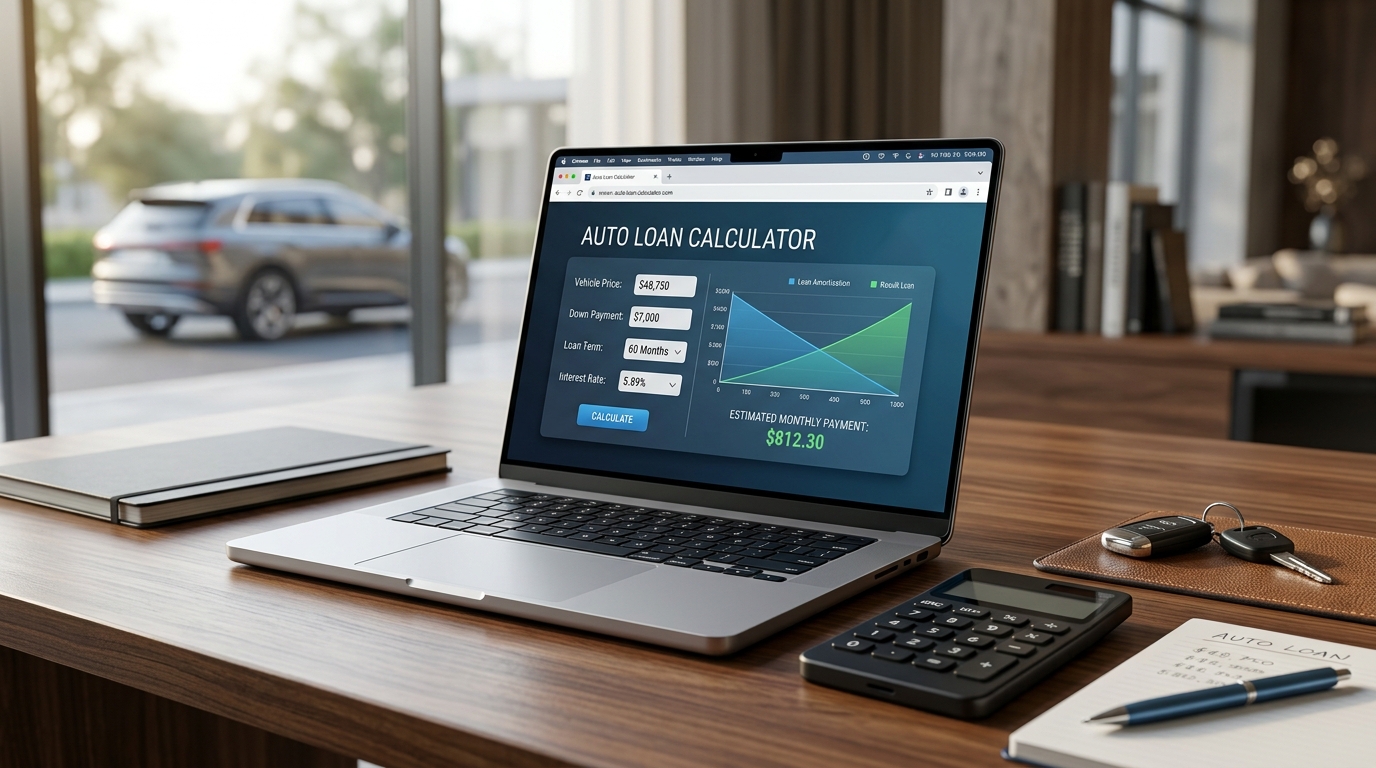
Buying a car is exciting, but the monthly payment can make or break your budget. An auto loan calculator turns sticker price, interest rate, and loan term into a single number you can plan around. Here’s how to use one without getting surprised at the dealership.
What an Auto Loan Calculator Actually Does
An auto loan calculator runs the same math a lender uses: the amortization formula. It takes your loan amount, annual percentage rate (APR), and term length, then solves for the fixed monthly payment that pays off the loan with interest by the end.
For a $30,000 loan at 7% APR over 60 months, the payment is $594. If the rate jumps to 9%, that same loan costs $623 monthly. That $29 difference adds up to $1,740 over five years. A calculator shows you that gap instantly.
Most online tools also display total interest paid and a full amortization schedule. That schedule breaks down how much of each payment goes to principal versus interest. Early payments are interest-heavy. By month 48 on a 60-month loan, most of your payment finally hits principal.
Why the Math Matters More Than the Sticker Price
Dealerships often focus on monthly payment, not total cost. A $35,000 car stretched over 84 months can look affordable at $510 monthly, but you’ll pay over $7,800 in interest at 7% APR. The same car on a 48-month loan costs $838 monthly but only $3,900 in interest.
Experian’s State of the Automotive Finance Market report shows the average new car loan term hit 68.5 months in 2023. Longer terms lower payments but raise total cost. A calculator makes that trade-off visible before you sign.
The Four Inputs That Change Everything
Every auto loan calculator needs four numbers. Small changes in any one of them swing your payment more than you’d expect.
- Loan amount: Vehicle price minus down payment, trade-in value, and rebates. A $3,000 down payment on a $28,000 car drops your loan to $25,000.
- Interest rate (APR): Determined by your credit score, lender, and whether the car is new or used. In early 2024, average new car APR was 7.2% for superprime borrowers and 14.7% for subprime, according to Experian.
- Loan term: Usually 24 to 84 months. Each extra year lowers the payment but adds interest.
- Sales tax and fees: Many calculators let you roll these in. In states like California, sales tax alone can add $2,500 to a $35,000 purchase.
In practice, the interest rate is the input you have the most control over. Improving your credit score from 650 to 720 can cut your APR by 3 to 4 percentage points. On a $25,000 loan over 60 months, that’s a savings of roughly $2,500.
How Down Payment Shifts the Math
Putting 20% down is the old rule of thumb, but it’s not just about lowering the loan. It also helps you avoid being upside-down, owing more than the car is worth.
Cars depreciate fast. A new vehicle loses about 20% of its value in the first year, per Edmunds data. If you finance 100% of a $30,000 car, you’re immediately underwater. A $6,000 down payment keeps you above water longer.
Try this: run the calculator with 0% down, then 10%, then 20%. On a $30,000 car at 7% for 60 months, 0% down means a $594 payment. With 20% down, it drops to $475. That’s $119 back in your pocket every month.
How to Use a Calculator Before You Shop
Start with your budget, not the car. Decide the maximum monthly payment you can afford without straining other bills. Financial planners often suggest keeping total transportation costs under 15% of take-home pay.
If you take home $4,500 monthly, that’s $675 for the car payment, insurance, gas, and maintenance. Insurance on a new car averages $1,800 yearly, or $150 monthly. That leaves about $525 for the loan itself.
Now work backward. At 7% APR for 60 months, a $525 payment supports a loan of about $26,500. Add a $4,000 down payment, and you’re shopping for cars priced around $30,500 before taxes and fees.
This approach flips the script. Instead of falling in love with a car and stretching to afford it, you know your ceiling before you step on the lot.
Don’t Forget the Extras
Dealerships add products like extended warranties, gap insurance, and paint protection. These get rolled into the loan, raising the amount financed. A $2,000 extended warranty on a 60-month loan at 7% adds $39 monthly and $400 in interest.
Ask for the out-the-door price and plug that number into your calculator. If it pushes you over budget, you can decline add-ons or negotiate the vehicle price down.
Sales tax varies widely. Oregon has no sales tax, while California’s base rate is 7.25% plus local additions. On a $30,000 car, that’s a $2,175 difference. Always check your state’s DMV or franchise tax board for the exact rate.
Comparing Offers with a Calculator
Dealers and banks compete for your loan. Using a calculator to compare offers side by side can save you hundreds.
Suppose Dealer A offers 6.9% for 60 months and Dealer B offers 7.4% for 72 months. The monthly payments look close, $593 vs. $518, but the 72-month loan costs $1,300 more in interest. The calculator reveals that the shorter term is cheaper overall if you can handle the higher payment.
Credit unions often beat dealership financing. A 2023 study by the Credit Union National Association found credit union auto loan rates averaged 1.5 percentage points lower than banks. On a $25,000 loan, that’s about $1,000 saved.
Get preapproved before you shop. A preapproval letter from your bank or credit union gives you a rate to compare against whatever the dealer offers. It also speeds up the paperwork.
Watch for Dealer Financing Tricks
Some dealers offer 0% financing but only if you give up a cash rebate. A $3,000 rebate versus 0% for 60 months: the rebate is better if you can get a loan under 4%. Run both scenarios through the calculator to see which wins.
Also, check whether the quoted rate is simple interest or precomputed. Most auto loans are simple interest, meaning you pay interest only on the outstanding balance. Precomputed loans charge interest on the full amount from day one, so paying early doesn’t save you as much.
When a Calculator Isn’t Enough
Calculators give you a solid estimate, but they don’t replace a lender’s exact numbers. Your actual APR depends on your credit history, income, debt-to-income ratio, and the lender’s policies.
If your credit score is below 600, expect rates above 15%. A $20,000 loan at 16% for 60 months costs $486 monthly and $9,160 in interest. That’s nearly half the loan amount again. In that case, improving your score first can save you thousands.
Also, some calculators don’t include fees like documentation, title, and registration. These can add $500 to $1,000 to your loan. Ask the dealer for a full breakdown before finalizing.
Finally, remember that a car loan is a depreciating asset. Unlike a mortgage, the thing you’re buying loses value every year. Keeping the term short and the down payment high limits how much you lose.
Conclusion
An auto loan calculator turns a confusing pile of numbers into one clear monthly figure. Use it before you shop, compare offers with it, and check the out-the-door price against your budget. A few minutes with the calculator can save you thousands over the life of the loan.
Q: How accurate are auto loan calculators?
They’re very accurate for the math, but they rely on the numbers you enter. If your actual APR or fees differ from your inputs, your real payment will too. Use them as a close estimate, then confirm with your lender for the exact figure.
Q: What credit score do I need for a good auto loan rate?
A score of 720 or higher typically gets you the best rates, often below 5% for new cars. Scores between 620 and 719 land in the average range, while anything under 620 usually means a double-digit APR. Check your score for free before applying.
Q: Is a longer loan term always worse?
Not always. A longer term lowers your monthly payment, which can help if cash flow is tight. But you’ll pay more interest overall and risk being upside-down longer. If you can afford the higher payment, a shorter term saves money.
Q: Should I include sales tax in the calculator?
Yes. Sales tax and fees get rolled into most auto loans, so excluding them gives you a payment that’s too low. Check your state’s tax rate and add it to the vehicle price before calculating. In high-tax states, this can add $2,000 or more to the loan.
Q: Can I use a calculator for a used car loan?
Absolutely. Used car loans often have higher rates, sometimes 1 to 2 percentage points above new car rates. Use the same calculator but input the used car APR and a shorter term, since lenders rarely offer 84-month terms on older vehicles.
Article Was Generated By AI.