Kelley Blue Book has priced American cars since 1926, and its values still anchor millions of used-car deals every year. But the number you see on the screen isn’t always the number you should pay. Knowing how to check a used car’s Blue Book value, and when to trust it, can save you thousands on your next purchase.
What the Blue Book Value Actually Measures
Kelley Blue Book (KBB) publishes three main numbers for any used vehicle: trade-in value, private-party value, and suggested retail value. Each one represents a different transaction, so mixing them up is the fastest way to overpay.
Trade-in value is what a dealer will likely give you when you hand over the keys and drive away in something else. It’s the lowest of the three because the dealer needs margin to recondition and resell the car.
Private-party value reflects a cash sale between two individuals, usually through a classified listing. Suggested retail value is what a dealership might charge after inspection, detailing, and warranty work.
According to KBB’s own methodology, these figures come from millions of actual transactions, auction data, and regional supply patterns. That’s why the same 2018 Honda Civic can show a $2,000 spread between Phoenix and Seattle.
Why the Spread Matters
If you’re buying from a dealer, the private-party number is your realistic target, not retail. If you’re selling, the trade-in number is your floor, not your goal.
In practice, shoppers who walk into a dealership quoting the private-party value often land within 3 to 5 percent of it. That’s a meaningful discount on a $20,000 vehicle.
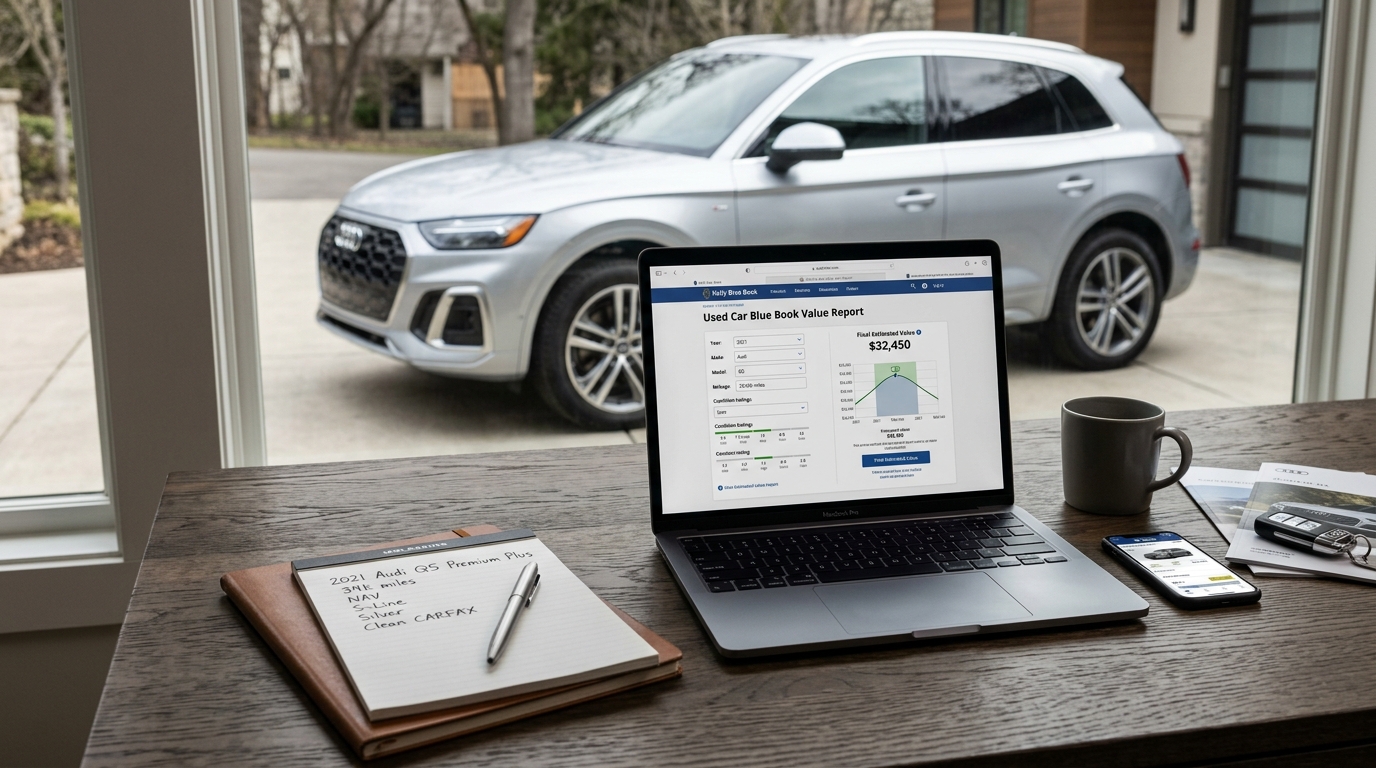
How to Look Up a Blue Book Value Step by Step
The KBB website and app walk you through a short form. Accuracy depends entirely on how honestly you answer each question, so take your time.
- Enter the vehicle’s year, make, model, and trim level. Trim matters more than most people realize. An EX-L and an LX can differ by $2,500 or more.
- Add the mileage. KBB uses 12,000 to 15,000 miles per year as a baseline. A 2019 car with 90,000 miles takes a serious hit.
- Select your ZIP code. Regional demand shifts values by hundreds or thousands of dollars.
- Choose the condition rating: excellent, very good, good, or fair. Be brutally honest here.
- Add options like sunroof, navigation, or a tow package. Most add-ons return only 10 to 30 cents on the dollar.
Once you submit, KBB shows all three values on one screen. Screenshot it. Dealers know these numbers too, and having them in hand keeps the conversation grounded.
Nailing the Condition Rating
KBB defines “excellent” as a vehicle with no mechanical or cosmetic flaws and fewer than average miles. That describes maybe 5 percent of used cars on the road.
“Very good” allows minor cosmetic issues but no mechanical problems. “Good” covers visible wear, like a small dent or worn tires. “Fair” means the car runs but needs work.
Most honest sellers land in “good” or “very good.” Selecting “excellent” on a car with a scratched bumper can inflate the value by $1,500 or more.
Where Blue Book Gets It Wrong
KBB is a guide, not gospel. It lags the market during fast shifts, and 2020 through 2022 proved that painfully. Used prices jumped roughly 40 percent in some segments while guidebooks scrambled to catch up.
Specialty vehicles are another weak spot. A well-kept Toyota Tacoma or Jeep Wrangler often sells above Blue Book because demand outstrips supply. KBB can’t fully capture that fever.
Conversely, sedans from brands with fading reputations can sit below the guide for months. If a car isn’t moving, the market is telling you something the book isn’t.
Cross-Check With Real Listings
Open a marketplace like Autotrader, Cars.com, or Facebook Marketplace and search the same year, model, and trim within 50 miles. Look at what sellers are asking, then note how long listings have been up.
A car listed for 60 days at $18,500 isn’t worth $18,500. It’s worth whatever someone eventually pays, which is usually less.
Industry analysts at Edmunds and Black Book publish their own values too. When three sources agree within $500, you’ve found the real number.
Using Blue Book Value to Negotiate
Walk in knowing three figures: the private-party value, the trade-in value, and the dealer’s asking price. That triangle gives you leverage.
If a dealer wants $21,000 for a car with a $17,500 private-party value, ask what justifies the $3,500 gap. Sometimes it’s a certified pre-owned warranty. Sometimes it’s nothing.
Certified pre-owned programs from manufacturers like Toyota, Honda, and BMW genuinely add value, often $1,000 to $2,000. An aftermarket warranty from a third party usually doesn’t.
Fees That Inflate the Price
Documentation fees, dealer prep, and “market adjustment” line items can add $1,500 or more to the out-the-door price. None of them appear in Blue Book values.
Ask for the out-the-door price in writing before you discuss monthly payments. Monthly payment talk is designed to hide the total.
In practice, the best negotiators get the price settled first, then mention their trade-in, then discuss financing. Mixing all three lets the dealer shuffle numbers between buckets.
When to Skip the Blue Book Entirely
Some cars defy guidebook pricing. Classic vehicles, heavily modified trucks, salvage-title cars, and anything over 200,000 miles fall outside KBB’s reliable range.
For those, you’ll want a specialist appraisal. Hagerty publishes values for collectible cars, and local appraisers charge $100 to $300 for a written opinion.
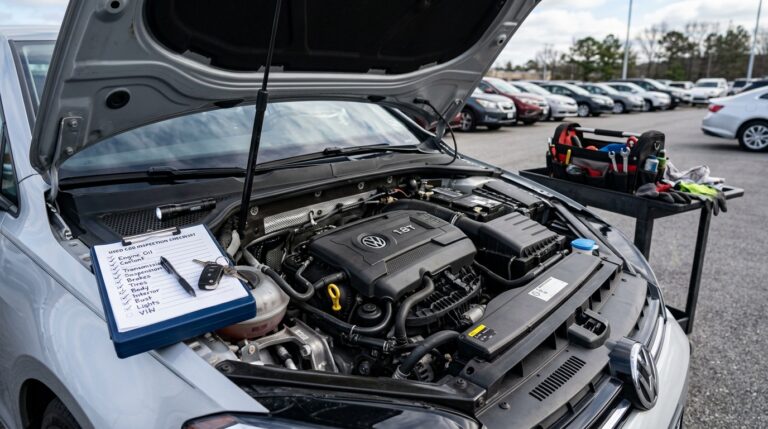
You should also get a pre-purchase inspection from an independent mechanic on any used car, regardless of price. A $150 inspection routinely uncovers $2,000 in hidden repairs.
Blue Book tells you what the market thinks a car is worth. An inspection tells you what this specific car will cost you. You need both numbers.
Conclusion
Checking a used car’s Blue Book value takes about five minutes and can save you thousands. Pull all three values, rate the condition honestly, and cross-check against live listings in your area. Then use the private-party figure as your anchor and the trade-in figure as your floor. The guide is a starting point. Your inspection, your research, and your willingness to walk away are what close a fair deal.
Q: Is Kelley Blue Book value the same as the price I should pay?
No. KBB publishes trade-in, private-party, and retail values, and each fits a different deal. If you’re buying from a private seller, the private-party number is your target. From a dealer, expect to pay somewhere between private-party and retail, depending on warranty coverage and reconditioning. Treat the figure as a benchmark, not a fixed price.
Q: How accurate is Blue Book value in 2024 and 2025?
It’s reasonably accurate for mainstream vehicles with average mileage, but it lags during rapid market shifts. Used prices swung roughly 40 percent between 2020 and 2022 while guidebooks caught up. For trucks, SUVs, and anything in unusual condition, cross-check with Edmunds, Black Book, and live marketplace listings before trusting a single number.
Q: Does mileage affect Blue Book value that much?
Yes. KBB uses 12,000 to 15,000 miles per year as its baseline. A car 30,000 miles above average can lose $2,000 to $4,000 in value, depending on the segment. Trucks and reliable models like the Toyota Camry absorb high mileage better than luxury sedans, which face steeper penalties and costlier repairs.
Q: Should I trust a dealer who says Blue Book doesn’t matter?
Sometimes they’re right, particularly on rare or high-demand vehicles. But if a dealer dismisses the guide entirely while quoting thousands above it, that’s a red flag. Ask for comparable sales data or a certified pre-owned warranty justification. Legitimate dealers can explain the gap. Vague answers usually mean the price is padded.
Q: Can I check Blue Book value for free?
Yes. The Kelley Blue Book website and mobile app provide free valuations for most vehicles. You’ll enter year, make, model, trim, mileage, ZIP code, condition, and options. Edmunds and NADAguides also offer free tools. For specialty or classic cars, paid services like Hagerty or a local appraiser give more reliable figures.
Article Was Generated By AI.