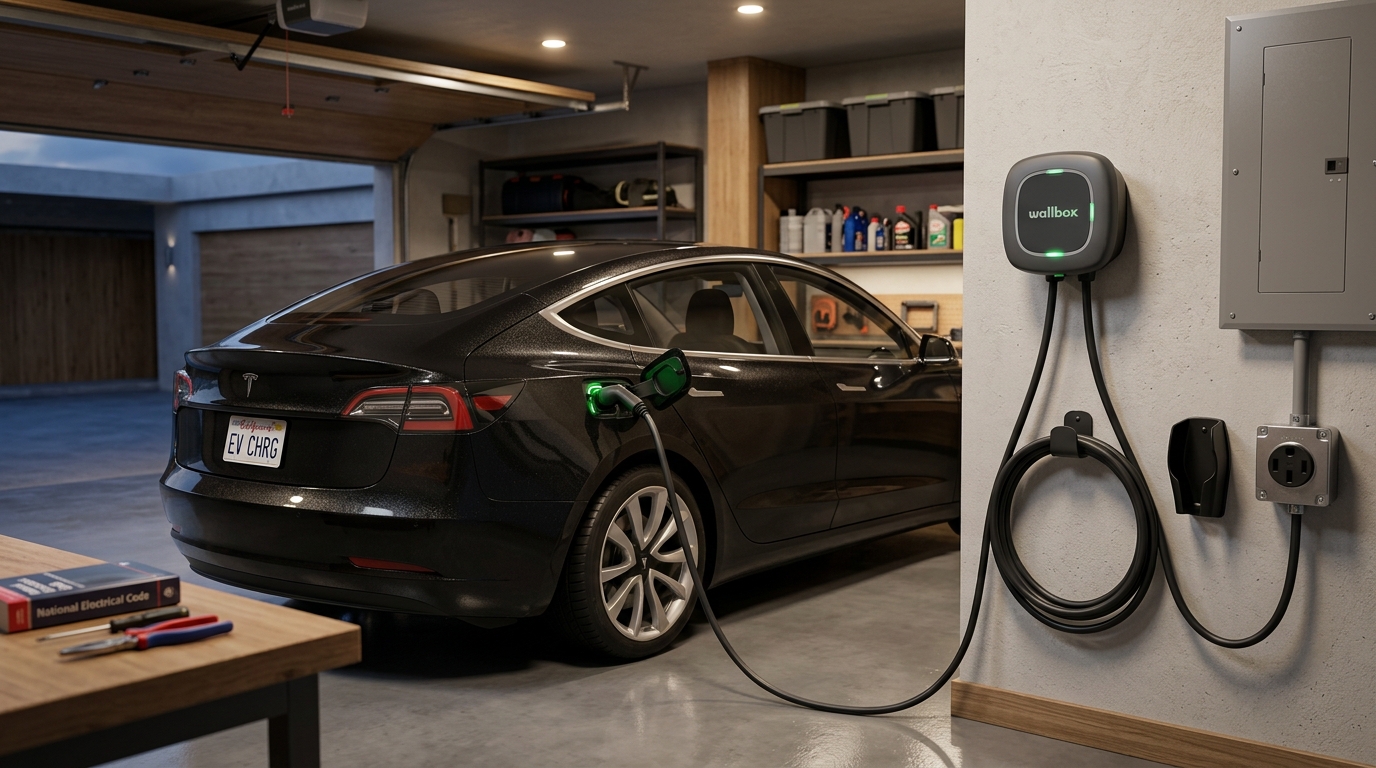
EV sales hit 1.4 million in the U.S. in 2023, according to Cox Automotive. If you just bought one, or you’re about to, the charging question lands fast. Public stations get the attention, but roughly 80% of EV charging happens at home. That’s where you’ll do most of your fueling, usually overnight while you sleep. Setting up home charging isn’t complicated, but a few decisions early on save you money and headaches later. Here’s what you actually need.
Level 1 vs Level 2: The Two Home Options
There are two ways to charge at home. One uses the outlet you already have. The other requires a dedicated piece of equipment and a licensed electrician. Both work. The right pick depends on your daily mileage and your car’s battery size.
Level 1: The Outlet in Your Garage
Every EV ships with a portable charging cord that plugs into a standard 120-volt household outlet. This is Level 1. It’s slow. You’ll add about 3 to 5 miles of range per hour.
For a car with a 300-mile battery, that’s two to three days for a full charge. If you drive 30 miles a day, plugging in at 6 p.m. gets you back to full by morning. That works for plenty of people.
The upside: zero installation cost. The downside: it’s genuinely slow, and a standard 15-amp circuit can’t always handle the load. Check that the outlet is on its own circuit and in good condition. An electrician can verify this in about 15 minutes.
Level 2: The 240-Volt Setup Most Owners Choose
A Level 2 charger runs on 240 volts, the same as your clothes dryer or oven. It adds 20 to 40 miles of range per hour, depending on the amperage. That’s a full charge overnight for nearly every EV on the market.
You can buy a Level 2 charger for $400 to $800. Installation runs $500 to $1,500, though prices climb if your electrical panel needs work. Some automakers, including Tesla and Ford, have offered free or discounted home chargers with new vehicle purchases. Check what your brand includes before buying separately.
In practice, most owners with a dedicated parking spot and a 200-amp panel go Level 2. The convenience gap between adding 4 miles per hour and 30 miles per hour is enormous.
What Your Electrical Panel Needs to Handle
Before you buy anything, figure out your panel’s capacity. Most modern homes have 200-amp service. Older homes may have 100 amps, and some have even less.
A Level 2 charger typically draws 32 to 48 amps. Adding that load to a 100-amp panel that’s already running an electric stove and air conditioner can trip the main breaker. An electrician will run a load calculation, which is a standard formula from the National Electrical Code.
If your panel can’t handle it, you have options:
- Upgrade the panel to 200 amps. Cost: $1,500 to $3,000.
- Install an energy management system that pauses charging when household demand spikes. Cost: $300 to $800.
- Choose a lower-amperage charger, like a 16-amp or 24-amp unit, that draws less power.
- Use a smart splitter that shares an existing 240-volt circuit with your dryer.
The energy management route is increasingly popular. Companies like DCC Electric and SPAN make devices that let you keep a smaller panel and still charge at a decent rate. For a 100-amp home, this can save thousands versus a full upgrade.
The Installation Process, Step by Step
You can’t DIY a 240-volt circuit in most jurisdictions. It requires a permit and a licensed electrician. Here’s how the process usually goes.
First, get quotes from at least three electricians who’ve installed EV chargers before. Ask specifically about EV experience. A general electrician who’s never wired a charger may miss details like breaker type, conduit routing, or local rebate paperwork.
Second, decide on placement. You want the charger near where you park, ideally on a wall or pedestal within reach of the charge port. Cord length matters. Most chargers have 18 to 25 feet of cable. If your parking spot is far from the house, you may need a pedestal mount, which adds $300 to $600.
Third, pull the permit. Your electrician usually handles this. Permit costs vary by city, typically $100 to $300. Don’t skip it. Unpermitted electrical work can void your homeowner’s insurance and cause problems when you sell.
Fourth, the install itself takes 3 to 6 hours for a straightforward job. Harder runs through finished walls, attics, or detached garages take longer and cost more.
After installation, the electrician should test the circuit and confirm the charger communicates properly with your car. Most chargers have an app that shows charging status. Set it up before the electrician leaves.
Costs, Rebates, and Tax Credits
Total setup cost for a Level 2 charger typically lands between $1,000 and $2,500, including equipment and labor. That’s the honest range. High-end chargers and complex installs push it higher.
The federal government offers a tax credit worth 30% of the cost, up to $1,000, for home charging equipment installed in eligible areas. This comes from the Inflation Reduction Act passed in 2022. The credit applies to the hardware, not the installation labor, so keep your receipts separate.
Many states and utilities pile on more. In California, PG&E and SCE offer rebates up to $1,000 for qualifying customers. In New York, Con Edison has a program that covers up to $1,500 for charger installation in certain areas. Check your utility’s website and your state energy office. These programs change often.
One more tip: some utilities offer lower overnight electricity rates for EV owners. Off-peak charging can cut your fuel cost to the equivalent of $1 per gallon. That’s worth a phone call to your provider.
Smart Chargers and What They Add
A smart charger connects to Wi-Fi and gives you control through an app. You can schedule charging for off-peak hours, monitor energy use, and get alerts if something goes wrong.
Some models integrate with home energy systems. If you have solar panels, a smart charger can prioritize charging when your panels are producing. That’s real savings if you’re on net metering.
Popular options include the ChargePoint Home Flex, Emporia Level 2, and Grizzl-E Classic. Prices range from $400 to $800. The Grizzl-E is a favorite for cold climates because it’s built in Canada and rated for extreme temperatures. The ChargePoint offers the widest range of amperage settings, which helps on smaller panels.
Do you need a smart charger? Not strictly. A basic Level 2 unit charges your car fine. But if you want to save on electricity or you have solar, the extra $100 to $200 is worth it.
Common Mistakes to Avoid
Buying a charger before checking your panel. This is the most common error. You might buy a 48-amp unit only to find your panel can’t support it. Get the load calculation first.
Hiring the cheapest electrician. EV charging is a specialized job. A bad install can damage your car’s onboard charger, which costs $1,500 to $3,000 to replace. Look for someone with EV-specific experience and good reviews.
Forgetting about cord management. A hanging cable gets dirty and tangled. A $20 hook or holster keeps things tidy and prolongs cable life.
Ignoring weather. If your charger is outdoors, make sure it’s rated for the elements. NEMA 4 or NEMA 3R ratings mean it can handle rain and snow. Most quality chargers have this, but check.
Skipping the permit. It’s tempting to save $200. Don’t. The risk isn’t worth it.
Conclusion
Home EV charging comes down to three decisions: what level you need, whether your panel can handle it, and who installs it. Level 1 works for low-mileage drivers. Level 2 is the practical choice for most. Get a load calculation before you buy hardware, hire an electrician with EV experience, and claim every rebate you qualify for. Do those things and you’ll charge at home for years with minimal fuss.
Q: How much does it cost to install a home EV charger?
Most homeowners pay between $1,000 and $2,500 total for a Level 2 charger and installation. The charger itself runs $400 to $800, and labor adds $500 to $1,500. If your electrical panel needs an upgrade, expect another $1,500 to $3,000. Federal tax credits can cover 30% of the hardware cost, up to $1,000.
Q: Can I install a home EV charger myself?
You can physically mount the unit and run the cable, but the 240-volt wiring must be done by a licensed electrician in most jurisdictions. It requires a permit and inspection. DIY electrical work can void your insurance and create safety hazards. Hiring a pro typically costs $500 to $1,500 and ensures the job meets code.
Q: How long does it take to charge an EV at home?
With a Level 1 (120-volt) charger, you’ll add about 3 to 5 miles of range per hour, so a full charge can take 40 to 60 hours. A Level 2 (240-volt) charger adds 20 to 40 miles per hour, giving a full charge in 6 to 12 hours. Most owners charge overnight and wake up to a full battery.
Q: What if my electrical panel can’t handle a Level 2 charger?
You have a few options. You can upgrade your panel to 200 amps for $1,500 to $3,000. Or install an energy management system for $300 to $800 that pauses charging when household demand is high. A lower-amperage charger or a smart splitter that shares a circuit with your dryer also works. An electrician can run a load calculation to find the best fit.
Q: Are there tax credits or rebates for home EV charging?
Yes. The federal Inflation Reduction Act offers a 30% tax credit up to $1,000 for home charging equipment in eligible areas. Many states and utilities add their own rebates. For example, California utilities offer up to $1,000, and Con Edison in New York covers up to $1,500 in some areas. Check your utility’s website for current programs.
Article Was Generated By AI.