You’re stuck in traffic on a 95-degree day, and your car’s AC is blowing air that feels like a hairdryer on low. It’s not just uncomfortable. It’s a safety issue when you can’t think straight. The good news is that most AC problems fall into a handful of categories, and some you can diagnose yourself in your driveway. Here’s what’s likely going on and what you can do about it.
Start With the Simple Stuff
Before you assume the worst, check the easy things. A cabin air filter clogged with leaves and dust can cut airflow by 50% or more. If you’ve never changed it in 30,000 miles, that’s your first suspect.
Next, look at the AC compressor clutch. With the engine running and AC on max, watch the compressor. The clutch should engage and spin the inner hub. If the outer pulley spins but the center doesn’t, the clutch isn’t engaging. That points to an electrical issue or low refrigerant pressure.
Also, check your blend door actuator. This small motor controls the flap that mixes hot and cold air. When it fails, you get warm air even with a perfectly working AC system. A quick test: set the temperature to full cold and listen for a clicking sound behind the dash. That’s a classic sign of a broken actuator.
Low Refrigerant: The Most Common Cause
In practice, low refrigerant is the number one reason car AC stops blowing cold. Your system is sealed, so refrigerant shouldn’t disappear. If it’s low, you have a leak.
Small leaks can happen at O-rings, Schrader valves, or hose connections. A shop can find them with UV dye or an electronic sniffer. Expect to pay $100 to $200 for a proper leak test.
Don’t just add a can of refrigerant from the auto parts store. Overcharging can damage the compressor. And if you have a leak, the new refrigerant will escape again. Fix the leak first, then recharge.
If you’re lucky, the leak is a simple O-ring that costs $2. But the labor to evacuate and recharge the system runs $150 to $250 at most shops.
Compressor Problems
The compressor is the heart of your AC system. It pressurizes refrigerant so it can absorb heat. When it fails, you get no cold air at all.
Signs of a bad compressor include a loud rattling noise when the AC is on, metal shavings in the refrigerant lines, or a compressor that won’t engage at all. A seized compressor can also snap the serpentine belt, leaving you stranded.
Replacing a compressor isn’t cheap. Parts alone run $300 to $800 for most cars, and labor adds $200 to $500. You’ll also need a new receiver-drier and an expansion valve, plus a full system flush. Total cost often lands between $800 and $1,500.
If your car is older and the compressor is dead, weigh the repair against the car’s value. Sometimes a $1,200 repair on a $2,000 car doesn’t make sense.
Electrical and Sensor Issues
Modern AC systems rely on sensors and computers. A faulty pressure switch, a blown fuse, or a bad relay can stop the compressor from engaging.
Check the fuse box first. The AC fuse is usually labeled and costs less than $1 to replace. If the fuse is fine, test the relay by swapping it with an identical one from another slot.
The pressure switch, also called the trinary switch, protects the compressor from running with too little or too much refrigerant. When it fails, the compressor won’t turn on. A replacement switch costs $20 to $60, and you can often swap it without discharging the system.
In some cars, the body control module or climate control module can fail. A diagnostic scan at a shop runs $100 to $150 and will pinpoint the issue.
Condenser and Cooling Fan Problems
The condenser sits in front of your radiator and releases heat from the refrigerant. If it’s clogged with bugs, leaves, or bent fins, airflow drops and cooling suffers.
You can clean the condenser with a garden hose and a soft brush. Just be gentle. Bent fins block airflow, so use a fin comb to straighten them.
Electric cooling fans are another common failure point. If the fan doesn’t run when the AC is on, the condenser can’t shed heat. At idle, your AC will blow warm. Once you’re moving, it might get cold again. That’s a telltale sign of a bad fan.
Replacing a cooling fan assembly costs $200 to $500, depending on the car. A fan relay or module is cheaper, usually $30 to $100.
What You Can DIY vs. What Needs a Shop
Some AC fixes are beginner-friendly. Others require specialized tools and training. Here’s a quick breakdown.
- DIY: Replace cabin air filter, check fuses and relays, clean condenser, inspect compressor clutch, replace blend door actuator on some models.
- Shop only: Leak detection, refrigerant recovery and recharge, compressor replacement, evaporator core replacement, electrical diagnostics.
Refrigerant handling requires a license in many places. And venting refrigerant to the atmosphere is illegal under Section 608 of the Clean Air Act. So even if you’re handy, leave the refrigerant work to a pro.
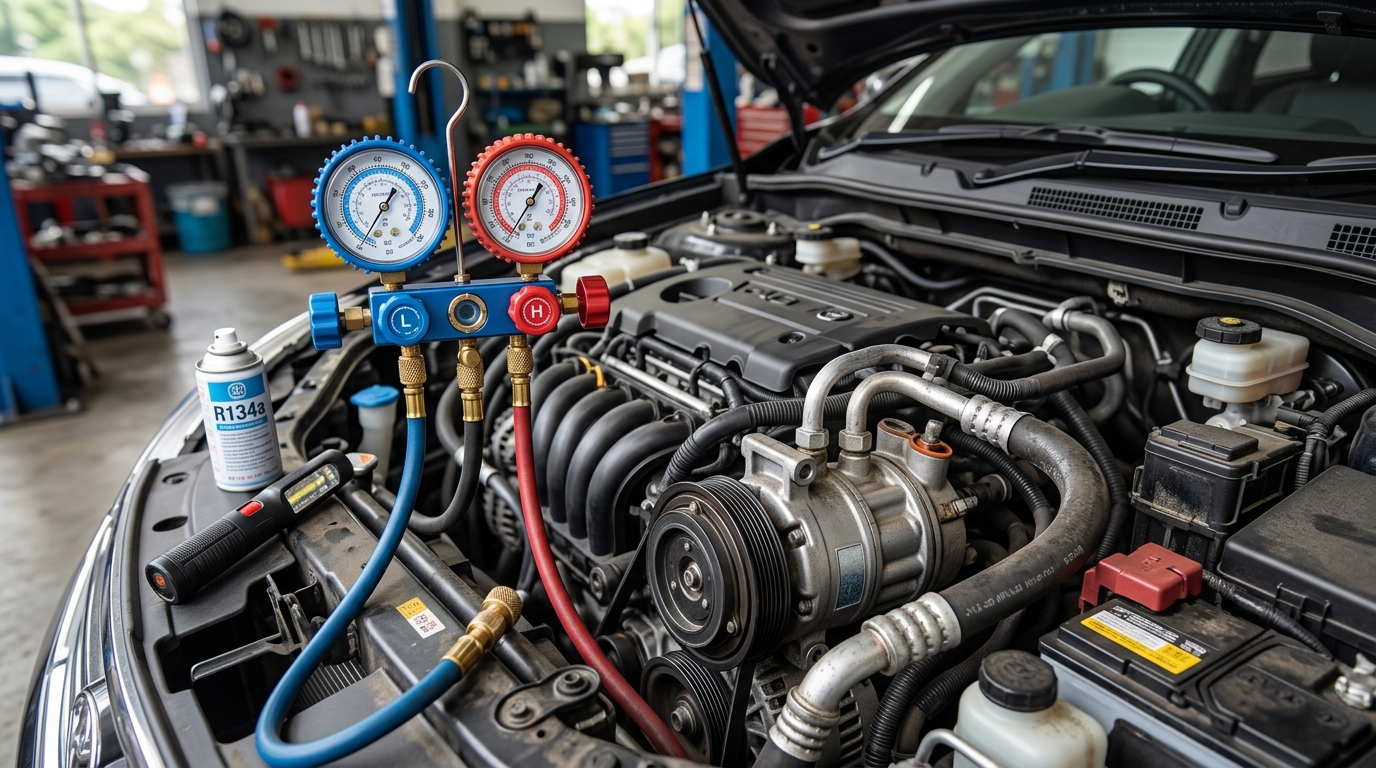
If you’re not sure where to start, a $100 diagnostic at a reputable shop can save you hours of guessing. Ask them to show you the pressure readings. Normal low-side pressure is 25 to 45 psi, and high-side is 200 to 250 psi, depending on ambient temperature.
Preventive Maintenance That Actually Works
Run your AC for 10 minutes every month, even in winter. This circulates lubricant and keeps seals from drying out. It’s the single best thing you can do for long-term AC health.
Change your cabin air filter every 15,000 to 20,000 miles. A clean filter means better airflow and less strain on the blower motor.
Keep the condenser clean. A quick rinse at every oil change takes two minutes and prevents bigger problems.
Finally, get your AC serviced every two to three years. A shop will check pressures, inspect for leaks, and top off refrigerant if needed. That $100 service can prevent a $1,200 compressor job.
Conclusion
When your car’s AC blows warm, start with the easy checks: cabin filter, fuses, and compressor clutch. If those are fine, low refrigerant or a failing compressor is the likely culprit. You can handle simple fixes yourself, but leave refrigerant work to a certified shop. A quick diagnostic now beats a costly repair later. Stay cool out there.
Q: How can I tell if my car AC just needs a recharge?
If the air is cool at highway speeds but warm at idle, low refrigerant is likely. You can check with a DIY gauge, but if it’s low, you have a leak. Adding refrigerant without fixing the leak is a temporary fix. A shop can find the leak and recharge properly for $150 to $250.
Q: Why does my AC blow cold on the driver’s side but warm on the passenger side?
This is a classic sign of a faulty blend door actuator or low refrigerant. In dual-zone systems, a broken actuator can’t move the temperature flap, so one side gets warm air. The part costs $30 to $80, and labor is usually 1 to 2 hours. It’s a common issue on many cars.
Q: Can I just add refrigerant from a store-bought can?
You can, but it’s risky. Overcharging damages the compressor, and most cans include sealant that can clog the system. If you have a leak, the new refrigerant will leak out too. It’s better to find and fix the leak first, then have a shop recharge the system with the exact amount of refrigerant.
Q: How much does it cost to fix a car AC that’s not blowing cold?
It depends on the cause. A recharge runs $150 to $250. A new compressor costs $800 to $1,500 installed. Electrical fixes like a relay or pressure switch are $50 to $200. A blend door actuator is $150 to $300. Get a diagnostic first, which typically costs $100 to $150, so you know what you’re facing.
Q: How often should I run my car’s AC to keep it working?
Run it for at least 10 minutes every month, even in winter. This circulates the compressor oil and keeps seals lubricated. Cars that rarely use AC develop leaks and compressor failures more often. It’s a free habit that can add years to your system’s life.
Article Was Generated By AI.