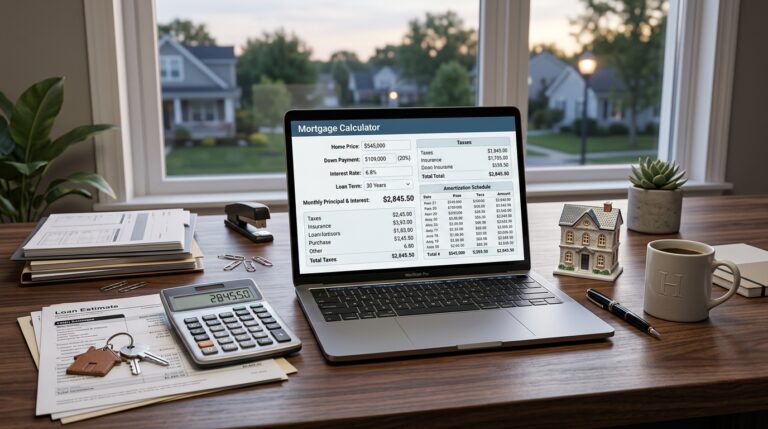
Mortgage rates move every day, and even a 0.5% difference can cost you tens of thousands over the life of a 30-year loan. On a $350,000 mortgage, the gap between a 6.5% and a 7.0% rate is roughly $110 more per month, or about $39,600 in extra interest. That’s real money. Understanding what pushes rates up or down gives you leverage when you negotiate. Here’s how current home loan rates work and how to land a better deal than the average borrower.
What Actually Drives Current Home Loan Rates
Mortgage rates aren’t set by a single bank or government office. They’re tied to the yield on 10-year Treasury notes and mortgage-backed securities (MBS), which trade constantly. When bond prices fall, yields rise, and mortgage rates follow. When investors get nervous and buy up bonds, yields drop and rates ease.
The Federal Reserve doesn’t set mortgage rates directly, but its decisions on the federal funds rate ripple through everything. In 2022 and 2023, the Fed raised rates 11 times, pushing the average 30-year fixed mortgage from around 3% to above 7% by late 2023, according to Freddie Mac’s Primary Mortgage Market Survey. That’s the fastest jump in four decades.
Inflation is the other big lever. When the Consumer Price Index runs hot, lenders demand higher yields to protect against eroding purchasing power. When inflation cools, rates tend to drift lower. The Bureau of Labor Statistics releases CPI data monthly, and mortgage markets react within minutes.
Why Your Rate Isn’t the Same as Your Neighbor’s
Two borrowers can get quotes 1% apart on the same day. Lenders price loans based on risk, and your personal profile tells them how risky you are. A 760 FICO score might get you a 6.4% rate while a 640 score could land at 7.5% or higher.
Down payment size matters too. Putting down 20% avoids private mortgage insurance (PMI) and signals lower risk. A 10% down payment often adds 0.25% to 0.5% to your rate, plus PMI costs of 0.3% to 1.5% of the loan annually.
Loan type and term change the math as well. A 15-year fixed typically runs 0.5% to 0.75% lower than a 30-year, but your monthly payment is higher because you’re paying it off twice as fast. Adjustable-rate mortgages (ARMs) often start lower, then reset after the fixed period ends.
The Hidden Costs That Widen the Gap
The interest rate is only part of what you pay. Points, origination fees, and closing costs can add 2% to 5% of the loan amount upfront. One discount point costs 1% of the loan and typically lowers your rate by 0.25%. On a $300,000 loan, that’s $3,000 for a quarter-point reduction.
Break-even math matters here. If a point costs $3,000 and saves you $50 a month, you need 60 months to recoup it. If you plan to sell or refinance in three years, buying points is a losing bet.
Lender fees vary wildly. A 2023 study from the Consumer Financial Protection Bureau found that borrowers with similar profiles paid between $700 and $3,500 in origination charges, depending on the lender. Shopping at least three lenders is the single most effective way to cut that spread.
How to Shop for the Best Rate Without Wrecking Your Credit
Rate shopping feels risky because you worry about credit dings. It’s not. FICO treats multiple mortgage inquiries within a 45-day window as a single inquiry. You can get quotes from five lenders and your score won’t take five hits.
Start with a full picture of your finances. Pull your credit reports from AnnualCreditReport.com, check for errors, and dispute anything wrong. Roughly 1 in 5 credit reports contains an error that could cost you a better rate, according to a 2021 Consumer Reports investigation.
Then get quotes from a mix of lenders: big banks, credit unions, online brokers, and local mortgage companies. Credit unions often beat banks on rates by 0.25% to 0.5% because they’re nonprofit and answer to members, not shareholders.
Questions That Separate Real Deals From Marketing Fluff
When you compare loan estimates, look past the headline rate. Ask each lender:
- What’s the APR, not just the interest rate? APR includes fees and gives a truer cost.
- Are there lender credits that lower my closing costs, and what rate do they come with?
- Can I get a float-down if rates drop before closing, and what does it cost?
- What’s the total origination charge, line by line?
- Is there a prepayment penalty if I refinance or pay off early?
Loan estimates are standardized by federal law, so line items sit in the same place across lenders. That makes side-by-side comparison easier than most people realize. Put three estimates next to each other and the cheapest deal often isn’t the one with the lowest advertised rate.
Timing the Market Without Driving Yourself Crazy
Nobody reliably predicts where rates go next. In early 2024, economists expected cuts that didn’t materialize until late in the year. Waiting for the perfect rate can cost you more than locking a good one.
In practice, the best strategy is to get preapproved, know your budget, and lock when the numbers work for your life. A rate that lets you comfortably afford the payment beats a hypothetical lower rate six months from now, especially if home prices keep climbing.
If you’re refinancing, the old rule of thumb is to wait until you can shave at least 1% off your rate. That’s outdated. With lower closing costs and faster processing today, a 0.5% drop can pay off within two years for many borrowers.
Small Levers That Add Up
Improving your credit score by 40 points before applying could drop your rate by 0.25% or more. Paying down a credit card balance to lower your debt-to-income ratio helps too. Lenders typically want DTI under 43%, though some allow up to 50% with compensating factors like large cash reserves.
A slightly larger down payment, even 5% instead of 3%, can reduce your rate and eliminate some fees. And asking your lender to match a competitor’s offer works more often than people think. It’s a business transaction, not a favor.
Conclusion
Current home loan rates depend on the bond market, the Fed, inflation, and your personal financial profile. You can’t control the first three, but you can control the last one. Check your credit, save for a bigger down payment, and get at least three loan estimates before you commit. A few hours of comparison shopping can save you $30,000 or more over 30 years. That’s the best deal you’ll ever negotiate.
Q: How often do home loan rates change?
Mortgage rates can shift daily, sometimes multiple times a day, based on bond market activity. Freddie Mac publishes a weekly average every Thursday, but individual lenders adjust their rates whenever Treasury yields move. If you’re actively shopping, check rates in the morning before locking, since intraday swings of 0.125% are common.
Q: Does the Federal Reserve set mortgage rates?
No. The Fed sets the federal funds rate, which affects short-term borrowing. Mortgage rates track the 10-year Treasury yield and mortgage-backed securities instead. Fed policy influences those markets indirectly, but a Fed rate cut doesn’t guarantee lower mortgage rates. In 2024, mortgage rates sometimes rose after Fed cuts because bond investors had already priced in the move.
Q: What credit score do I need for the best mortgage rate?
You’ll generally get the lowest rates with a FICO score of 760 or higher. Scores between 700 and 759 get competitive rates with minor adjustments. Below 680, expect to pay noticeably more. Improving your score by even 20 to 40 points before applying can lower your rate by 0.25% or more, which adds up to thousands over the loan term.
Q: Is it worth paying discount points to lower my rate?
It depends on how long you’ll stay in the home. One point typically costs 1% of the loan and reduces your rate by about 0.25%. Divide the cost by your monthly savings to find the break-even month. If you’ll stay past that point, points can save money. If you might sell or refinance sooner, skip them.
Q: Can I negotiate my mortgage rate?
Yes, and you should. Lenders have room to compete, especially if you bring a written loan estimate from a rival. Ask for a rate match or a reduction in origination fees. Credit unions and online lenders tend to be more flexible than big banks. Even a 0.125% reduction saves roughly $25 a month on a $300,000 loan.
Article Was Generated By AI.